• Skip to main content
  • Skip to primary sidebar

TravelAbility Insider

The Intersection of Travel and Disability

lkarl

Celebrating Disability Pride Month with a Behind the Scenes Tour of Google’s Accessibility Discovery Center 

July 27, 2026 by lkarl Leave a Comment

July brings together three meaningful milestones: America’s 250th birthday, Disability Pride Month, and the anniversary of the Americans with Disabilities Act. Each celebrates freedom in its own way, but together they remind us that independence is only meaningful when everyone has the opportunity to experience it.

That spirit of opportunity is exactly what Amy Tarpein of Elijah’s Baby Bucket List discovered during a behind-the-scenes visit to Google’s Accessibility Discovery Center in New York City. Their visit is a hopeful reminder that when we design with disabled people, not just for them, we create a future where more people can experience the freedom to explore.

A Celebration of Possibility at Google’s Accessibility Discovery Center in NYC

Written by Amy Tarpein

Amy Tarpein and Jake from TravelAbility pose with three others, including a young wheelchair user, in front of a large illuminated interactive light wall at Google's Accessibility Discovery Center.

On the first day of Disability Pride Month, our family stepped into a space that felt like the future: Google’s Accessibility Discovery Center (ADC) in New York City. Guided by our friend Sasha, an accessibility engineer at Google, and joined by Jake from TravelAbility, we spent the afternoon inside a living laboratory where inclusive design isn’t an afterthought. It’s the foundation.

Beginning Disability Pride Month with Intention

Before exploring the center, we gathered in Google’s free café, coffee in hand, snacks within reach, around a table, talking about the future of accessibility. That conversation set the tone for the entire visit: thoughtful, intentional, and rooted in community. Starting Disability Pride Month in a place built around innovation felt symbolic, almost like the universe nudging us forward.

A Space Built for Possibility

Walking into the ADC felt like stepping into tomorrow. Every corner held prototypes, tools, and interactive experiences designed to make the world more navigable for people with disabilities. The mini‑humans dove right in, testing features, exploring adaptive tech, and discovering how thoughtful design can reshape everyday life. It is inclusion at its best!

And this work isn’t limited to New York. Google has established Accessibility Discovery Centers in cities all over the world, like London and São Paulo, expanding inclusive innovation across continents. Standing inside the NYC center, it was powerful to know this commitment is global. 

What’s at the Center

A 'Hearing' station at Google's Accessibility Discovery Center displays a live speech-to-text demo on a laptop and tablet, with a young person testing the technology at the desk.

The ADC is organized into four main areas, each one designed to spark curiosity, collaboration, and possibility.

  • Research Lab – equipped to record usability testing sessions, capturing real‑time feedback from people with disabilities so engineers can refine products with lived experience at the center.
  • Assistive Experiences -featuring accessories that simulate certain impairments and hands‑on demonstrations of assistive tech used in daily life. The kids loved exploring how different tools support different needs.
  • Workshop Space -a collaborative environment for ideation, reading, and building. It’s where engineers, designers, and community members come together to imagine what accessibility can look like next.
  • Accessibility Discovery Center Arcade – a favorite for the mini‑humans. They tested game equipment designed for people who cannot use traditional controllers, opening up the opportunity for Elijah and Isaiah to play the dinosaur game together for the very first time.

We explored Braille keyboard options, learned about products designed inside the center, tried out adaptive games, and watched assistive technology come alive in ways that felt both practical and magical.

Innovation Meets Lived Experience

Sasha, a Google accessibility engineer and wheelchair user, gestures while presenting the 'Maps for everyone' display, featuring a laptop showing StreetReaderAI research and a poster on disability statistics, at the Accessibility Discovery Center.

Having Sasha guide us added a depth that can’t be replicated. He didn’t just show us technology, he shared the why behind it. The lived experiences. The feedback loops. The engineering challenges. The victories that come from designing with disabled communities, not just for them.

Jake brought the TravelAbility perspective, and we brought our lived‑experience lens connecting tech innovation to real‑world travel accessibility. Together, we created an afternoon that felt like a masterclass in what inclusive design can look like when passion meets purpose.The mini‑humans even got to mark go to Google on business off the bucket list! We spent the afternoon testing adaptive tech, giving feedback, and helping share ideas to make the center even better and the boys got to play a game together for the very first time!

Two boys play together at the ADC Arcade adaptive gaming station, one of whom is a wheelchair user, testing an accessible game controller.

The Heart of Disability Pride Month

Watching the kids explore, play a game together for the first time, and test new features side‑by‑side, fully included, fully welcomed, was the kind of moment that stays with you. In the photo to the left, Elijah is playing a video game using only his toes, demonstrating how adaptive gaming technology can open the door to experiences that traditional controllers often make impossible. Disability joy, innovation, travel, and community aren’t separate ideas. They’re intertwined. And inside the ADC, that truth was unmistakable.

Gratitude for the Changemakers

We’re deeply grateful to Sasha for opening the doors to this incredible space, and to Jake for continuing to work toward accessibility in travel. Their work, along with the work happening in Google’s Accessibility Discovery Centers worldwide, is shaping a future where families like ours can move through the world with more ease, more dignity, and more joy.

It wasn’t just a tour.

It was a celebration of possibility.

Sasha explains an accessibility demo to Amy Tarpein and Jake from TravelAbility at a desk inside Google's Accessibility Discovery Center.

Share this:

  • Share on Facebook (Opens in new window) Facebook
  • Share on LinkedIn (Opens in new window) LinkedIn
  • Print (Opens in new window) Print
  • Share on X (Opens in new window) X

Filed Under: Lived Experience, Technology Tagged With: accessibility innovation, Accessible technology, Accessible travel, Americans with Disabilities Act, assistive technology, Disability Pride Month, disability travel, Elijah's Baby Bucket List, Google, Google Accessibility Discovery Center, inclusive design, inclusive travel, New York City, travel accessibility, TravelAbility

Text-only description: Why Vision 2030 — The Accessibility Moonshot? (Full infographic)

May 6, 2026 by lkarl

Creator: TravelAbility. Purpose: Connect aging baby boomer demographics with rising demand for accessible, multigenerational travel.

Baby Boomer demographics in 2030

  • Average net worth: $1.2 million per household (Yahoo Finance).
  • Hold 50% of U.S. wealth (Federal Reserve, Distributional Financial Accounts).
  • 72% are retired (U.S. Labor Department, 2024).
  • 40% (about 30 million) of Americans 65+ will live with a disability (McKinsey & Company).

Travel data

  • 44% of grandparents have taken a multigenerational trip with their grandchildren; roughly half help pay (AARP).
  • 57% of parents plan to travel with grandparents and children, potentially influencing 35% of all travel (Family Travel Association).
  • 18% of traveler parties included someone who required accessibility services in 2025 (Longwoods International 2025 Survey).
  • 30,000 monthly accessibility requests to a major cruise line call center (source noted as confidential).
  • $75 million in accessible luxury travel sold by Fora advisors in 2025 (Fora).
  • 70% plan to travel this year, averaging 27 travel days (AARP 2025).

Fun facts

  • Japan, where 25% of the population is 65+, produces more adult diapers than children’s.
  • By 2030, 23% of the U.S. population will be 65+ (~40 million; U.S. Census).

Visual layout

Top banner with a rocket launch and headline. Demographics row uses images of a modern house, a penny, older adults on a bench, and an older hiker. Travel data grid includes a beach walk of a grandparent and child, a donut‑style 57% graphic, a wheelchair user icon with 18%, a cruise ship at sunset for 30,000 requests, an airplane near the 70% stat, and a plated meal image near the $75M stat. Bottom band shows a red Japanese pagoda and a calendar icon labeled 2030.

Share this:

  • Share on Facebook (Opens in new window) Facebook
  • Share on LinkedIn (Opens in new window) LinkedIn
  • Print (Opens in new window) Print
  • Share on X (Opens in new window) X

Filed Under: Text-Only Infographic Descriptions

Text-only description: Who Will Be Impacted by Disability in 2030?

May 6, 2026 by lkarl

Creator: TravelAbility. Purpose: Visualize how many people are directly connected to disability through aging, caregiving, and family relationships.

Key points (as shown)

  1. People over 65 living with a disability: 30 million. Description notes significant mobility, cognitive, or other challenges.
  2. Household partners: 33 million. Daily caregivers, partners, and spouses supporting loved ones. Calculation shown: average 1.1 partners × 30M = 33M.
  3. Immediate family (children and grandchildren): 225 million. A wide network who support, care for, and connect with family members who have disabilities. Calculation shown: 7.5 × 30M = 225M.
  4. Total household + immediate family: 288 million lives connected.

Visual layout

Four stacked panels with friendly line‑art: older adults (some with mobility aids) and rows of small icons representing 1 million each; a partner pushing a wheelchair and caregiving scenes; groups of children and grandchildren; and a large family group above the headline “288 million lives connected.”

Share this:

  • Share on Facebook (Opens in new window) Facebook
  • Share on LinkedIn (Opens in new window) LinkedIn
  • Print (Opens in new window) Print
  • Share on X (Opens in new window) X

Filed Under: Text-Only Infographic Descriptions

Ask the Experts: What Disabled Travellers Really Want

April 12, 2026 by lkarl

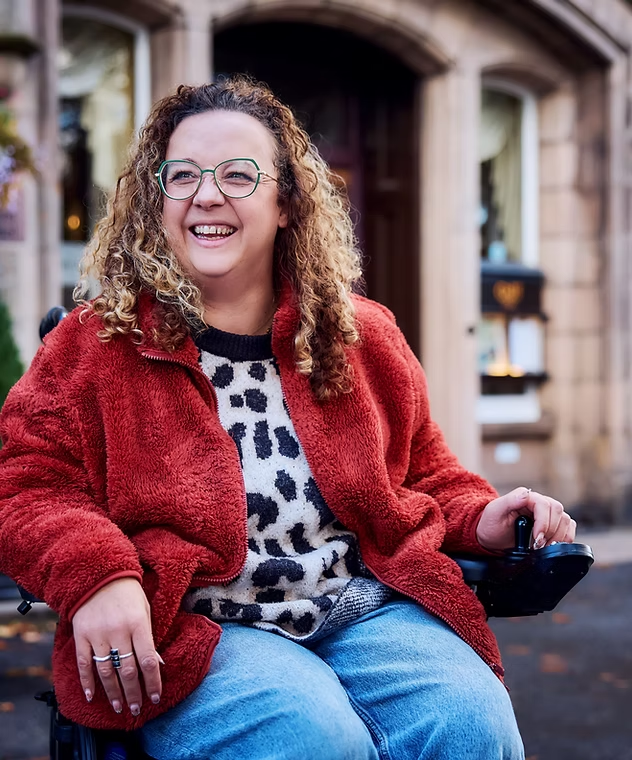
Carrie-Ann Lightley, a woman with curly hair and glasses, smiles while seated in a wheelchair outdoors in front of a building entrance. She wears a red jacket over a patterned sweater and appears relaxed and confident.

What do disabled travelers really want? Accessibility writer Carrie-Ann Lightley delivered the scoop – after asking disabled travelers from across the UK for tips to pass on to travel agents. Her article for Selling Travel uncovers the unexpected priorities of disabled travelers.

“How many bookings have you lost because a provider says ‘we’re not sure if that’s accessible’?

As a wheelchair user and specialist in accessible travel, I’ve heard these words too often. Accessible travel isn’t a mystery, it’s an opportunity.”

Carrie highlights the top three priorities of the disabled traveler as:

  • clear information, 
  • transparent communication, 
  • and empathy.

Clear Information

“Clarity beats perfection every time.”

Carrie shared input from travelers across a variety of disabilities, but all agreed with Allie Mason, autistic author and accessible travel advocate, who stated: “We’re looking for clear and up-to-date accessibility information. We don’t need ‘perfect’, just enough to know if a provider can meet our needs.”

Transparent Communication

“Ask questions, listen, and offer choices that balance both practicality and joy.” 

It’s important to acknowledge that there’s no such thing as “fully accessible.” One contributor noted that, “What works for one traveller can create barriers for another.”

Active listening helps travel planners craft realistic itineraries—leading to better trips, not broken promises.

Empathy

“Small actions shape the whole experience.”

It’s important to remember that “a disabled traveller is never trying to be difficult; they simply want equitable access.”

Travelers, all of them, want to feel seen. They deserve to experience the journey of a lifetime… and that experience will keep them coming back for more.

Read the Article Here

Share this:

  • Share on Facebook (Opens in new window) Facebook
  • Share on LinkedIn (Opens in new window) LinkedIn
  • Print (Opens in new window) Print
  • Share on X (Opens in new window) X

Filed Under: Accessibility, Lived Experience, Travel

Celebrate Autism Awareness Month with My Brother Otto

April 12, 2026 by lkarl

Meg Raby sits indoors holding her children’s book *My Brother Otto*, with multiple copies displayed behind her on shelves and the floor. She faces the camera, clearly presenting the book in a cozy home setting.

Celebrate Autism Awareness Month with a children’s story by our very own Meg Raby of KultureCity.

My Brother Otto

By Meg Raby

My Brother Otto is a picture book following the story of a young crow on the spectrum, and his loving big sister.

Meg shared, “I wrote My Brother Otto, a children’s picture book about an autistic, nonspeaking Crow, for myself. For young Meg.

I wrote it in hopes of highlighting the humanity and need for neurology differences and how it is okay and good and right to ask questions.

How we can look to Otto’s older sister on just how to be curious and inclusive. How we can look to Otto to appreciate the joy he exudes daily while acknowledging some of the challenges he faces. I wrote it for you. No matter your age.”

Buy Here

Share this:

  • Share on Facebook (Opens in new window) Facebook
  • Share on LinkedIn (Opens in new window) LinkedIn
  • Print (Opens in new window) Print
  • Share on X (Opens in new window) X

Filed Under: Advisory Board, Autism, Neurodiversity, The Arts

  • Go to page 1
  • Go to page 2
  • Go to page 3
  • Interim pages omitted …
  • Go to page 30
  • Go to Next Page »

Primary Sidebar

Subscribe Now to TravelAbility Insider

Get insider accessibility updates right to your inbox

Our promise: Your name and email will never be sold to third parties.

Recent Posts

  • Beyond Sight: How Red Sea Global Is Designing Inclusive Experiences for Blind Travelers 

Recent Comments

    Archives

    Categories

    • Accessibility (413)
    • Accessibility Awards (56)
    • Accessibility Champion of Change (10)
    • Accessibility Funding (27)
    • Accessibility Playbook (13)
    • Accessible Experience of the Month (6)
    • Accessible Landing Pages (39)
    • Accessible Meetings (24)
    • Accessible Travel (2)
    • ADA//Law (69)
    • Adaptive Sports (34)
    • Advice Line (7)
    • Advisory Board (25)
    • Airlines (104)
    • Ambassador Report (8)
    • Amputees (6)
    • Around The Web (1)
    • Artificial Intelligence (1)
    • Autism (70)
    • Baby Boomer Travel (9)
    • Best Practices (4)
    • Blind and Low Vision Travel (26)
    • Conferences & Events (81)
    • Content Creators (7)
    • COVID-19 (19)
    • Cruising (11)
    • Deaf abd Hard of Hearing (1)
    • Destination of the Month (6)
    • Destinations (19)
    • Digital Accessibility (35)
    • Disability Advocates (181)
    • Disability Awareness (151)
    • Editorial (76)
    • Education (31)
    • Emerging Markets Summit 2024 (9)
    • EmergingMarketsSummit23 (14)
    • Expert Q&A (56)
    • Explorable Podcast (3)
    • Family Travel (48)
    • Fashion (10)
    • Food (10)
    • Government (29)
    • Hearing (50)
    • Hidden Disabilities (50)
    • Hotel Spotlight (3)
    • Hotels (115)
    • Innovation of the Month (10)
    • Innovations and Products (4)
    • Lived Experience (18)
    • Mental Health (12)
    • Mobility (140)
    • Museums & Attractions (55)
    • Neurodiversity (80)
    • One for the Books (2)
    • Parks and Public spaces (90)
    • Plus Size Travel (6)
    • Products (67)
    • Resources (1)
    • Restaurants (20)
    • Service Animals (10)
    • Speakers 2019 (11)
    • Surveys (9)
    • Sustainability (13)
    • Technology (116)
    • Text-Only Infographic Descriptions (2)
    • The Arts (48)
    • The Business Case (7)
    • Tourism (54)
    • Transportation (77)
    • Travel (259)
    • Travel Industry People (79)
    • TravelAbility 2021 (10)
    • TravelAbility 2022 (9)
    • TravelAbility Events (5)
    • TravelAbility Summit (57)
    • TravelAbility Week 2020 (3)
    • Trends (107)
    • Uncategorized (169)
    • Video of the Month (7)
    • VIRTUAL2020 (4)
    • Vision (71)
    • Vision 2030: The Accessibility Moonshot (1)
    • What would you do? (4)
    • Wheelchair Travel (1)

    An industry service provided by

    Copyright © 2026 · Metro Pro on Genesis Framework · WordPress · Log in

    SUBSCRIBE TODAY!

    Your name and email will never be sold to third parties.

    SUBSCRIBE TODAY!

    Your name and email will never be sold to 3rd parties.

    Loading Comments...

    You must be logged in to post a comment.