• Skip to main content
  • Skip to primary sidebar

TravelAbility Insider

The Intersection of Travel and Disability

Accessibility

Ask the Experts: What Disabled Travellers Really Want

April 12, 2026 by lkarl

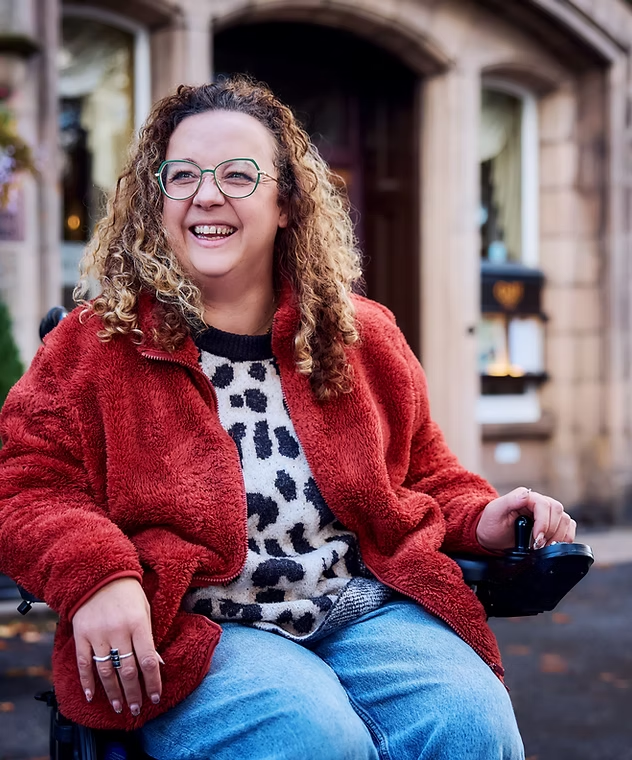
Carrie-Ann Lightley, a woman with curly hair and glasses, smiles while seated in a wheelchair outdoors in front of a building entrance. She wears a red jacket over a patterned sweater and appears relaxed and confident.

What do disabled travelers really want? Accessibility writer Carrie-Ann Lightley delivered the scoop – after asking disabled travelers from across the UK for tips to pass on to travel agents. Her article for Selling Travel uncovers the unexpected priorities of disabled travelers.

“How many bookings have you lost because a provider says ‘we’re not sure if that’s accessible’?

As a wheelchair user and specialist in accessible travel, I’ve heard these words too often. Accessible travel isn’t a mystery, it’s an opportunity.”

Carrie highlights the top three priorities of the disabled traveler as:

  • clear information, 
  • transparent communication, 
  • and empathy.

Clear Information

“Clarity beats perfection every time.”

Carrie shared input from travelers across a variety of disabilities, but all agreed with Allie Mason, autistic author and accessible travel advocate, who stated: “We’re looking for clear and up-to-date accessibility information. We don’t need ‘perfect’, just enough to know if a provider can meet our needs.”

Transparent Communication

“Ask questions, listen, and offer choices that balance both practicality and joy.” 

It’s important to acknowledge that there’s no such thing as “fully accessible.” One contributor noted that, “What works for one traveller can create barriers for another.”

Active listening helps travel planners craft realistic itineraries—leading to better trips, not broken promises.

Empathy

“Small actions shape the whole experience.”

It’s important to remember that “a disabled traveller is never trying to be difficult; they simply want equitable access.”

Travelers, all of them, want to feel seen. They deserve to experience the journey of a lifetime… and that experience will keep them coming back for more.

Read the Article Here

Share this:

  • Share on Facebook (Opens in new window) Facebook
  • Share on LinkedIn (Opens in new window) LinkedIn
  • Print (Opens in new window) Print
  • Share on X (Opens in new window) X

Filed Under: Accessibility, Lived Experience, Travel

TravelAbility Summit Cheat sheet: The State of Accessibility in Travel Today 

April 12, 2026 by lkarl

Each month we share a recap from one of the sessions at the 2025 TravelAbility Summit. Check out the opening session on the state of accessible travel today.

Speakers 

  • Jake Steinman – Founder, TravelAbility 
  • Arturo Gaona –Chief Partnerships Officer, Wheel the World
  • Kristy Durso – Founder, Incredible Memories Travel / Ambassador, TravelAbility 

Session Overview 

This session traced the evolution of accessible travel from a compliance-based approach to a marketing-driven movement rooted in inclusion, innovation, and economic opportunity. The panel reflected on industry growth since 2019—when accessibility was largely overlooked—to 2025, where it’s becoming a mainstream priority. Speakers highlighted personal experiences, technological progress, and the increasing recognition of accessibility as both a moral and financial imperative. 

Key Insights 

  • 2019: Accessibility was an afterthought, often managed without dedicated budgets or plans. 
  • 2021–2022: Awareness grew as data from Open Doors and other research groups revealed accessibility’s market value. 
  • 2025: Accessibility has transitioned from Destination Development to Marketing, signaling industry maturity and opportunity. 
  • Data Shift: Longwoods International now reports 18% of U.S. travelers require accessibility services—an upward trend. 
  • Personal Connection: Every traveler is affected by accessibility in some way, either directly or through family and companions. 
  • Industry Growth: TravelAbility expanded from 60 to nearly 200 attendees annually, reflecting accelerating industry engagement. 

Actionable Takeaways 

  • Invest intentionally: Accessibility needs to be budgeted and planned, not just funded by grants. 
  • Integrate marketing: Position accessibility as a core part of destination branding, not an add-on. 
  • Leverage influencers: Content creators drive visibility and authenticity in accessible travel marketing. 
  • Provide clarity: Offer detailed, accurate accessibility information so travelers can make informed choices. 
  • Use provided tools: TravelAbility will share template pages and AI-assisted surveys for destinations, hotels, and attractions to collect and present accessibility data consistently.

Notable Quotes 

  • “Accessibility has become the new big movement—just like sustainability was 20 years ago. If you aren’t pursuing it now, you’ll get left behind.” — Kristy Durso
  • “The ADA was written for the median—it works for half the people and not for the other half. Because there’s no ADA for information, travelers don’t know which half they’re in until they arrive.” — Jake Steinman 
  • “We can’t depend on grants to move accessibility forward. We need to budget for it, plan for it, and recognize the ROI.” — Arturo Gaona 

Want to be part of these conversations in real time? 

2026 TravelAbility Tampa 2026 ad featuring a group of people including a wheelchair user enjoying a mead in downtown tampa. the summit dates are listed.

Join us November 9–11, 2026, in Tampa, Florida, for the 2026 TravelAbility Summit. It’s where destinations, venues, and travel brands come together to advance accessibility in a practical, business-smart way. Over two days of case studies, workshops, and peer learning, industry leaders share proven strategies that improve the travel experience for people with disabilities—and, by extension, for families, multigenerational groups, and travelers with temporary or situational limitations. Meet the advisors, suppliers, and destination teams leading the way, and leave with a roadmap you can put to work immediately.

Register Today

Share this:

  • Share on Facebook (Opens in new window) Facebook
  • Share on LinkedIn (Opens in new window) LinkedIn
  • Print (Opens in new window) Print
  • Share on X (Opens in new window) X

Filed Under: Accessibility, The Business Case, Travel, Trends

Visit Lansing’s New Route to Accessible Wayfinding with AARP

April 10, 2026 by lkarl

Julie Pingston wearing a purple blazer smiles at the camera while standing indoors near a row of glass windows. The setting appears to be a professional office or hallway.

For nearly a decade, Julie Pingston has been quietly shaping what accessibility looks like in Lansing, Michigan. What began with sensory-friendly programming has grown into something much larger, more embedded, and, as she describes it, “simply part of how the community operates.” It’s definitely something to be proud of.

Now, that work is expanding beyond venues and experiences and into the streets themselves.

A Walking Audit with Purpose

The newest initiative is a partnership with AARP Michigan centered around what is known as a “walking audit.” 

“This walking audit,” Pingston explains, “is a training on how to do a walking audit. This is what we’re calling a train-the-trainer.”

The concept is collaborative and practical. Teams move through a community together, walking and rolling through public spaces to evaluate how accessible they truly are. The goal is not just observation, but education and replication.

“It’s a team that goes through wayfinding, curb cuts, lighting, visual and audio cues, identifying barriers,” she says.

Rather than receiving a report from an outside evaluator, participants are immersed in the process themselves. 

“You’re going through with them,” she says. “It’s not that they just send you a report. You’re learning together.” This lived experience, instead of a report on paper, brings us one step closer to true understanding.

“The synergy of that one day, will spill out when everybody learns and takes that knowledge back to wherever it makes sense to implement. Some people might want to do that in their own neighborhood. Some people might want to do it along our river trail, or incorporate bike trails. It’s a very robust program.”

The Inspiration

Pingston has a reputation for prioritizing accessibility and inclusion, so she was excited when AARP Michigan reached out to her for this initiative. “It just makes sense with everything TravelAbility has been saying with the growth in the aging population and all of these amassing and overlapping needs as we move forward.” 

AARP connected with Pingston at just the right moment, on a call during last year’s TravelAbility Summit, when she was already in go-mode applying all that she was learning. Thanks to AARP’s online toolkit, getting started is easy.

From Awareness to Action

The audit examines the everyday details that can make or break accessibility.

“It will identify a lot of those things that are a hindrance to mobility,” Pingston says. “It could be that the crosswalk signals are not audio, they’re only visual. It focuses on lighting as well. Is it pedestrian friendly or not? Are there proper curb cuts? Are there visual cues or auditory cues missing?”

Some barriers are less obvious until you experience them firsthand.

“In our downtown, I can think of a place with large planters about a third of the way into the pedestrian path,” she says. “For someone with low vision or using a mobility device, these are an impediment. I don’t know how people don’t walk right into them.”

The audit also pushes communities to think more broadly about infrastructure.

“One of the things I want to cover is a road downtown that goes 45 miles an hour through a busy intersection near our convention center,” she notes. “How do we identify the impact on the walkability of the city, and then how do we elevate change?”

That question sits at the heart of the initiative.

“My goal is to have change affected by this,” Pingston says. “Not just identifying issues, but making sure we can point them out and have them addressed.”

What We Mean by “Walk” 

While the program is called a walking audit, Pingston is quick to expand the definition.

“I’m really trying to shift that,” she says. “Let’s think of people rolling, and walkers, and strollers, and everything that needs to move down this path.”

That mindset aligns closely with broader conversations across the accessibility space, particularly as aging populations and disability needs increasingly overlap.

How You Can Hop On Board

For destination marketing organizations looking to follow suit, Pingston emphasizes that the barrier to entry is lower than it might seem.

“Check out the online toolkit,” she says. “You don’t even have to sign up as an AARP member. You can go on and get the toolkit.”

From there, DMOs can scale up.

“If your community wants to do the bigger step, reach out to your local or statewide AARP to partner with them,” she advises. “There may be a grant for the facilitation process.”

The facilitator component, which Lansing is utilizing, helps deepen the learning and ensures participants know what to look for.

“I might know personally that something doesn’t look right,” Pingston says. “But there are things I don’t know. There’s so much value in doing it as a team effort and learning together.”

Building a Case for Change

One of the most significant outcomes of the audit is not just awareness, but documentation.

“It’s going to provide a documented resource that the community or the city can use as a tool going forward,” Pingston explains. “A lot of people know things anecdotally, but once you put it all in one package and say, this is how we can make this better, it becomes something people can prioritize.”

That shift from anecdotal to actionable is where real progress happens.

An Accessibility Champion’s Next Move

For Pingston and her team, the walking audit is one step in an ongoing journey.

“You never want to just be set with what you’ve done,” she says.

Future plans include expanding accessibility efforts into sports and education, building on Lansing’s strong foundation.

“We have a very vibrant sports commission,” she says. “So how can we take what we’ve done on the visitor and meetings side and transfer that over to sports? We’re a Big Ten university destination, so there are a lot of opportunities to connect with adaptive sports.”

At the same time, the sensory inclusive work that started it all continues to thrive.

“It has not wavered,” Pingston says. “Everyone we brought in is still engaged. We have not lost any of them. It’s become routine.”

And that may be her greatest accomplishment of all.

“It’s become routine,” she repeats. “This isn’t going to go away.”

For other destinations, that consistency offers both inspiration and a roadmap. Start with intention, build with community, and keep going until accessibility is no longer an initiative, but simply the way things are done.

Share this:

  • Share on Facebook (Opens in new window) Facebook
  • Share on LinkedIn (Opens in new window) LinkedIn
  • Print (Opens in new window) Print
  • Share on X (Opens in new window) X

Filed Under: Accessibility, Baby Boomer Travel, Destinations, Disability Awareness, Mobility, Neurodiversity

Leave No Attendee Behind: Ensuring Accessibility is Key

March 9, 2026 by lkarl

What does it take to truly “leave no attendee behind”? In this feature by Matt Swenson on themeetingmagazines.com, our founder and CEO, Jake Steinman, reflects on how the TravelAbility Summit moved from good intentions to measurable improvements for attendees with disabilities. With insights from experts across the accessible travel landscape, it’s a comprehensive look at why making access a priority at meeting and events is good for people and good for business. The story details why ADA checkboxes aren’t enough, what we learned by hosting 21 creators with disabilities at the 2025 Summit, and how partners like Travel Oregon and Wheel the World are setting a new bar with destination-wide accessibility verification. It’s a practical guide to what planners need from venues and cities—and how transparent details like room specs, routes, seating, assistive technology, and staff readiness turn promises into predictable experiences.

To help convention centers deliver on that standard consistently, we’re launching TravelAbility Approved: Convention Centers—a pilot program designed to provide accessibility to meeting venues so that attendees of all abilities can attend. Four DAC DMOs will lead the first cohort as we establish clear criteria, consistent reporting, and public-facing access profiles, backed by staff training and operational playbooks. Pilot venues will be featured in USAE News to share lessons learned and gauge industry demand—creating a trusted signal planners can use and attendees can rely on.

Read the article below, and stay tuned as we roll out the pilot and invite additional convention centers and DMOs to join future cohorts.

Leave No Attendee Behind: Ensuring Accessibility is Key

By Matt Swenson

Jake Steinman, founder and CEO of the TravelAbility Summit, used to describe the annual event as a travel conference built around accessibility and not an accessibility conference built around travel.

His mindset changed when the lone deaf attendee at a past event gave him a piece of her mind when she learned no American Sign Language translators were onsite. “I realized we need to walk the walk,” Steinman says.

As proof of progress, TravelAbility hosted 21 influencers with various disabilities at its 2025 conference in Oregon at Sunriver Resort, a scenic, outdoorsy destination near the Cascade Mountains that is about 45 minutes from the closest airport.

Nevertheless, Travel Oregon was the first bidding on the event with the intent of proving they are a model of accessibility, notes Steinman, who launched TravelAbility in 2019 and has created a range of travel-based conferences over the past quarter-century.

The fact that a conference dedicated to improving the experience for disabled travelers required a wake-up call is just one example of how the events industry lags behind serving a vast community many will eventually join as they get older.

According to the 2024 Destinations International’s Global Accessibility Report, 35% of survey respondents had the resources in place to make the meeting and event experience more accessible. That means that more than two-thirds were not prepared to meet the demand.

Meanwhile, Longwoods International, a hospitality-centered research firm, found in 2023 that 17% of American travelers identify as having a disability.

Arturo Gaona, chief partnerships officer & founding member at Wheel the World, an online platform that provides accessible travel planning and booking services for people with disabilities, estimates that the accessibility travel market is a multibillion dollar industry. But it has the potential to be much more, he says.

The travel industry has not been actively taking care of travelers with disabilities, he says. “Eighty percent of them are having bad experiences.”

While Gaona isn’t distinguishing between leisure and business travel in his analysis, evidence points to the meetings industry struggling to match the demand from those who need an extra hand.

Sherrif Karamat, CAE, president and CEO of the Professional Convention Management Association (PCMA) and the Corporate Event Marketing Association (CEMA), is among those ready to see improvements. “One area that I’m hoping that all of society can do better for is people with disabilities and special needs,” he says. “I don’t think that we do a good enough job.”

Continue Reading

Share this:

  • Share on Facebook (Opens in new window) Facebook
  • Share on LinkedIn (Opens in new window) LinkedIn
  • Print (Opens in new window) Print
  • Share on X (Opens in new window) X

Filed Under: Accessibility, Accessible Meetings, Conferences & Events, Travel Industry People, TravelAbility Summit

Capturing the Accessible Luxury Market – How FORA Travel Booked $75 Million in Travel 

March 9, 2026 by lkarl

Accessible luxury is a growth story hiding in plain sight—and the results speak for themselves. At the 2025 TravelAbility Summit, Karen Morales shared how to capture this market by treating accessibility as core hospitality and equipping advisors with the right tools. Check out the session recap below.

2026 TravelAbility Tampa 2026 ad featuring a group of people including a wheelchair user enjoying a mead in downtown tampa. the summit dates are listed.

Want to be part of these conversations in real time? Join us November 9–11, 2026, in Tampa, Florida, for the 2026 TravelAbility Summit. It’s where destinations, venues, and travel brands come together to advance accessibility in a practical, business-smart way. Over two days of case studies, workshops, and peer learning, industry leaders share proven strategies that improve the travel experience for people with disabilities—and, by extension, for families, multigenerational groups, and travelers with temporary or situational limitations. Meet the advisors, suppliers, and destination teams leading the way, and leave with a roadmap you can put to work immediately.

Register Today!

Session Recap

Karen Morales speaking on stage at a the 2025 TravelAbility Summit while seated in a power wheelchair and holding a microphone.

Speakers 

● Karen Morales — Fora Travel (luxury travel agency) 

● Kristy Durso – Founder, Incredible Memories Travel / Ambassador, TravelAbility 

Session Overview 

Karen Morales described how accessible travel intersects with the luxury segment, sharing her rapid transition to mobility disability and the gap she found between adaptive recreation progress and inconsistent accessibility at five-star properties. Partnering with Fora, she helped train advisors to sell accessibility in luxury—and suppliers are starting to listen when accessibility is framed as hospitality and revenue, not just compliance. 

Key Insights 

  • Advisor training moves markets: In one year, 300+ Fora advisors were trained on selling accessibility, contributing to ~$75M in accessible travel sales (within a company targeting ~$1B total). 
  • Supplier blind spot: Major brands rarely include accessible rooms, food-allergy handling, or autism supports in sales decks—yet many have untapped assets (e.g., properties with numerous accessible rooms, beach wheelchairs, adaptive surf). 
  • Luxury clients, real scenarios: 
    • Multi-gen Greece (14 ppl): privacy for an immunocompromised traveler. 
    • “Bill,” 82, first overseas trip in a wheelchair: premium cabins; practical questions like airplane bathroom access. 
    • High-spend allergy travel: families flying a private chef; $200k itineraries. ○ Safaris, Europe villas, river cruises (often less accessible). 
  • Policy & momentum (as stated by speaker): New builds in New York require an accessible room in each room category; similar practices cited in Boston and London. National and destination campaigns spotlighting accessibility were noted (e.g., Australia; interest in Japan, Spain, U.K., Colombia). 
  • Hospitality > compliance: The winning pitch to luxury suppliers is guest welcome, ease, and revenue—“meeting individual needs” as core hospitality. 

Actionable Takeaways 

  • Communicate clearly: It’s “not an infrastructure problem, it’s a communications challenge.” Publish accessible room counts by category, doorway/bed/bath specs, allergy protocols, and on-site equipment. 
  • Package accessibility: Provide ready-to-use lists for advisors: accessible rooms by tier, vetted transfer options, adaptive excursions (e.g., surf, ski, golf-cart city tours), and how to book them. 
  • Make access effortless: Beach mats and wheelchairs on demand (simple signup, no bureaucracy). Train front-of-house so staff know what exists on property.
  • Show proof: Share short videos and real guest stories demonstrating access; partner with creators to amplify wins.
  • Connect the dots locally: Link hotels and DMO partners with adaptive providers (e.g., National Ability Center in Park City) so concierge pre-arrival emails include inclusive options. 

Notable Quotes 

  • “Where can I go? People aren’t limited by dreams—they’re limited by the box they think they now live in.” — Karen Morales 
  • “We’re not talking about compliance—we’re talking about hospitality.” — Karen Morales

Share this:

  • Share on Facebook (Opens in new window) Facebook
  • Share on LinkedIn (Opens in new window) LinkedIn
  • Print (Opens in new window) Print
  • Share on X (Opens in new window) X

Filed Under: Accessibility, The Business Case, Travel, Travel Industry People

  • Go to page 1
  • Go to page 2
  • Go to page 3
  • Interim pages omitted …
  • Go to page 83
  • Go to Next Page »

Primary Sidebar

Subscribe Now to TravelAbility Insider

Get insider accessibility updates right to your inbox

Our promise: Your name and email will never be sold to third parties.

Recent Posts

  • Disability Opportunity Fund to Host Accessible Innovation Showcase at The Schoolhouse Hote

Recent Comments

    Archives

    Categories

    • Accessibility (413)
    • Accessibility Awards (56)
    • Accessibility Champion of Change (9)
    • Accessibility Funding (27)
    • Accessibility Playbook (12)
    • Accessible Experience of the Month (6)
    • Accessible Landing Pages (39)
    • Accessible Meetings (24)
    • Accessible Travel (1)
    • ADA//Law (69)
    • Adaptive Sports (34)
    • Advice Line (7)
    • Advisory Board (25)
    • Airlines (103)
    • Ambassador Report (8)
    • Amputees (6)
    • Around The Web (1)
    • Artificial Intelligence (1)
    • Autism (70)
    • Baby Boomer Travel (9)
    • Best Practices (4)
    • Blind and Low Vision Travel (25)
    • Conferences & Events (80)
    • Content Creators (7)
    • COVID-19 (19)
    • Cruising (11)
    • Destination of the Month (6)
    • Destinations (18)
    • Digital Accessibility (34)
    • Disability Advocates (180)
    • Disability Awareness (151)
    • Editorial (76)
    • Education (31)
    • Emerging Markets Summit 2024 (9)
    • EmergingMarketsSummit23 (14)
    • Expert Q&A (56)
    • Explorable Podcast (3)
    • Family Travel (48)
    • Fashion (10)
    • Food (10)
    • Government (29)
    • Hearing (50)
    • Hidden Disabilities (50)
    • Hotel Spotlight (3)
    • Hotels (115)
    • Innovation of the Month (8)
    • Innovations and Products (1)
    • Lived Experience (14)
    • Mental Health (12)
    • Mobility (140)
    • Museums & Attractions (55)
    • Neurodiversity (80)
    • One for the Books (2)
    • Parks and Public spaces (89)
    • Plus Size Travel (6)
    • Products (67)
    • Resources (1)
    • Restaurants (20)
    • Service Animals (10)
    • Speakers 2019 (11)
    • Surveys (9)
    • Sustainability (12)
    • Technology (115)
    • Text-Only Infographic Descriptions (2)
    • The Arts (47)
    • The Business Case (6)
    • Tourism (54)
    • Transportation (77)
    • Travel (259)
    • Travel Industry People (79)
    • TravelAbility 2021 (10)
    • TravelAbility 2022 (9)
    • TravelAbility Events (5)
    • TravelAbility Summit (54)
    • TravelAbility Week 2020 (3)
    • Trends (106)
    • Uncategorized (168)
    • Video of the Month (7)
    • VIRTUAL2020 (4)
    • Vision (71)
    • Vision 2030: The Accessibility Moonshot (1)
    • What would you do? (4)
    • Wheelchair Travel (1)

    An industry service provided by

    Copyright © 2026 · Metro Pro on Genesis Framework · WordPress · Log in

    SUBSCRIBE TODAY!

    Your name and email will never be sold to third parties.

    SUBSCRIBE TODAY!

    Your name and email will never be sold to 3rd parties.

    Loading Comments...

    You must be logged in to post a comment.