• Skip to main content
  • Skip to primary sidebar

TravelAbility Insider

The Intersection of Travel and Disability

Eliana Satkin

Campers and Accessibility: Bridging the Gap in Outdoor Experiences

March 4, 2024 by Eliana Satkin

A landmark study by Kampgrounds of America (KOA) identifies the needs of campers with disabilities

Campgrounds offer an idyllic landscape to adventurous travelers: sun-kissed trees, the scent of pine in the air, and families and friends sharing stories around the campfire. But the beautiful scene isn’t attainable for everyone as a recent study by Kampgrounds of America (KOA) revealed. KOA surveyed a percentage of campers at its 500+ campgrounds in the US and Canada and found some eye-opening statistics about the needs of campers with disabilities. 

 1. The Disability Divide:

  • 27% of U.S. residents report having a disability. These are our neighbors, colleagues, and friends—individuals navigating life with unique challenges.
  • Now, consider the campers. 38% of them also identify as having a disability. Campers are 41% more likely to have a disability than the average U.S. resident.
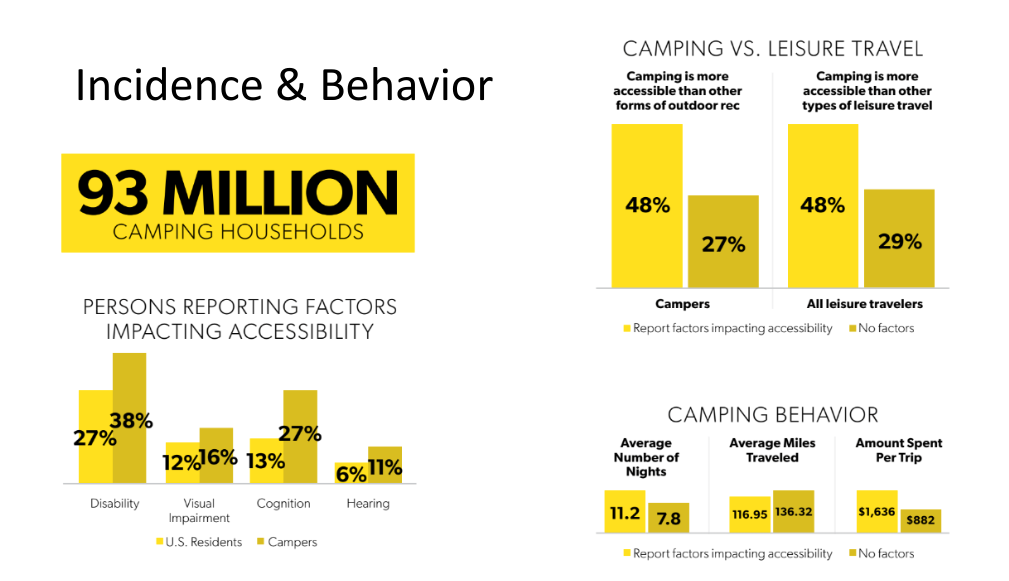
Slide showing statistics from the study: Campers report more factors impacting accessibility than the general public does with disability at the top of the list of factors; camping is considered about as accessible as other types of leisure travel by both groups; individuals who report more barriers to accessibility of campgrounds spend more nights and more money camping but travel shorter distances than those reporting no barriers.

2. Beyond the Surface: Factors Impacting Accessibility:

  • Visual Impairment:
    • Among U.S. residents, 12% grapple with visual impairments. The world appears through a different lens for them.
    • Campers, too, face this reality. 16% of them navigate trails, campfires, and sunsets with altered vision. Yet, they persist, guided by determination and perhaps the rustle of leaves underfoot.
  • Cognition:
    • Cognitive disabilities—including neurodiversity and autism spectrum disorder affect 13% of U.S. residents, Within the camping community, this percentage more than doubles as 27% of campers wrestle with cognitive challenges. 
  • Hearing
    • For 6% of U.S. residents, hearing impairment shapes their world. Yet, they find solace in nature’s symphony. Among campers, 11% navigate the same trails, attuned to vibrations, sign language, and the silent beauty of dawn breaking over the horizon.

3. The Call for Inclusivity:

  • Campgrounds, take note: ramps, accessible facilities, and thoughtful design matter. Let’s bridge the gap between adventure and accessibility.
  • Because when campers—regardless of ability—sit by the fire, they share not only s’mores but also stories of resilience, laughter, and the wild beauty that binds us all.

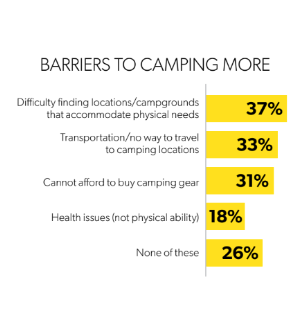
Following the lead of more and more state and national parks, Kampgrounds of America, are joining the movement to improve and increase access to beautiful, natural, and often remote outdoor spaces. 

Senior executives from Kampgrounds of America will be participating in panels at the  Travelability EMS Summit in San Francisco, November 13-15 about their plans to implement  more accessibility features along with staff and franchisee training to be more welcoming for everyone.

Share this:

  • Share on Facebook (Opens in new window) Facebook
  • Share on LinkedIn (Opens in new window) LinkedIn
  • Print (Opens in new window) Print
  • Share on X (Opens in new window) X

Filed Under: Family Travel, Hearing, Parks and Public spaces Tagged With: camping, demographics, outdoor activities, research, survey

News from the TravelAbility Movement: Recognitions, People, Events, Grants

March 4, 2024 by Eliana Satkin

Photo of a beach scene behind the headline "Wheelchair-Accessible Beach Towns"

Best wheelchair-accessible beach towns?

Myrtle Beach, South Carolina and Lincoln City Oregon make the list

Logo of Destinations International

Tourism for All training: First cohort graduates from innovative professional development

Program developed by Charlottesville CVB and Destination International 

Airbnb logo on top of a photo of an usual house on the top of a hill

Airbnb’s most popular accessible rentals:

TravelAbility Advisor Suzanne Edwards of Airbnb comments on the growing popularity of Airbnb’s Adaptive category

Head shot of John Morris on top of a cityscape of Fort Wayne

Visit Fort Wayne Event:

John Morris to deliver keynote at Visit Fort Wayne’s Power of Tourism event in May

Text "Dating with Disabilities" on top of a photo of a young man in a wheelchair holding hands and touching forehead to forehead with a young woman

Dating with Disabilities:

TravelAbility Advisor Chelsea Bear interviewed for PBS Newshour segment

Logo of the Destination Ally Club: Changing the world one Destination at a time

Destination A11Y

Notes from the Destination A11Y Club Winter Meeting

Share this:

  • Share on Facebook (Opens in new window) Facebook
  • Share on LinkedIn (Opens in new window) LinkedIn
  • Print (Opens in new window) Print
  • Share on X (Opens in new window) X

Filed Under: Accessibility, Disability Advocates, Family Travel, Hotels, Tourism Tagged With: Beaches, media coverage, rentals

TravelAbility Trusted: EnChroma Glasses for Color Blindness

March 4, 2024 by Eliana Satkin

Q&A with Kent Streeb, VP of Communications & Partnerships

Q & A with Kent Streeb of Enchroma Glasses, plus headshot

Beyond being a hidden disability, color blindness is an underestimated one. The fact that the EnChroma glasses tied for first in the InnovateABLE competition at EMS 2023 is a testament to the strength of Kent Streeb’s presentation and the data he presented about the effects of color blindness. To cite one telling statistic from a recent study by EnChroma, nearly three quarters of respondents say they feel “left out” or disappointed in trips to museums, gardens and parks because they cannot fully experience the colors. We talked with Kent about his background and the impact of the glasses. 

Q1:   Tell us about yourself and how you came to be involved in the field of assistive innovations for people with disabilities. 

My late step sister-in-law was severely disabled, wheelchair-bound and non-verbal. My mother-in-law has severe mobility constraints. My firsthand experiences traveling with both of them to places like Kauai, or to local beaches in the Bay Area, always illustrated the additional burdens travel poses for those with mobility challenges, from simple issues with access to others. It made me realize how critical it is for organizations to consider accessibility. I also served in the Peace Corps in West Africa working in rural healthcare. I witnessed so many addressable health conditions related to vision, mobility and others that caused people everyday pain and obstacles. This furthered my interest in seeking to work for a company that helps people.

In terms of EnChroma, my dad is color blind. I thought I knew all about it but after joining EnChroma soon realized that I was highly ignorant of how he sees colors, the issues it can cause in daily life, and how it can detract from their interest in travel to colorful destinations and/or in navigating travel. Everything from where to park (red or green painted curbs/zones) to catching the correct subway train based on a color-coded route map, to being able to interpret colored trails on a map at a park, can all cause confusion and frustration. Moreover, since color blind people only see 10% of the one million hues and shades visible to others, things like going to a colorful tropical location, to see art at a museum, experiencing the colors of a botanical garden, taking a trip to see the fall colors, or looking at a rainbow, can all be less interesting.

Q2:    How long have you been in business and what is your escalator pitch (longer than elevator but shorter than a full explanation) for your innovation?

One in 12 men (8%) and one in 200 women (.5%) are color blind – 13 million in the US, 30 million in Europe, and 350 million worldwide. For them, understanding colorful information in school, at work, in nature, during travel, at museums and in daily life can cause obstacles. While people with normal color vision see over one million shades of color, the red-green color blind only see an estimated 10% of hues and shades. Common color confusions include green and yellow, gray and pink, purple and blue, and red and brown, with colors appearing muted and dull. This creates frustration for people who are CVD and detracts from their ability to fully experience colors in art, nature, sports and travel.

EnChroma’s patented lens technology is engineered with special optical filters that enable people with red-green color blindness to see an expanded range of colors more vibrantly, clearly and distinctly. The glasses can help the color blind more fully participate in life’s colorful moments and overcome confusion and frustration in school, at work, and in daily life. The glasses work for 8 of 10 red-green color blind people, results and reaction times vary and they are not a cure or fix for color blindness.

Q3:  What travel, or travel-adjacent problem does your innovation address? How might a destination introduce it to their stakeholders?

Color blindness is a factor that destinations need to address. An EnChroma study of color blind people found that half of respondents said color blindness affects their interest in going to art and other museums (49%), and over three-fourths feel “left out” or disappointed in trips to art museums, gardens and parks because they cannot fully experience the colors. Roughly three of four (71.88%) find it challenging to understand maps, brochures, signage and exhibits that convey information via colors at museums, parks, tourist destinations and concerts. And 84% say venues rarely or never consider their needs in their usage of colors.

It is very easy for destinations to introduce EnChroma glasses or our color blind-adapted scenic viewfinders for visitors to enjoy. Visitors can easily borrow the glasses for colorful activities or for a day or duration of their stay. This is done at scores of tourist attractions around the world. In fact, EnChroma is the lead advocate for “color accessibility” through its EnChroma Color Accessibility Program™. The program helps over 400 organizations purchase viewers for the color blind and/or loan EnChroma glasses to color blind students and guests at 30 K-12 schools, 15 universities, 50 state and national park locations across 20 states, 200 public libraries, 100+ museums, and seven tourism departments.

Through partnerships with leading vendors, scenic viewers adapted for the color blind with EnChroma lenses are also available. The program is open to employers. EnChroma donates a pair of glasses for every pair purchased by an organization that plans to loan the glasses to the public to enhance accessibility and inclusion. An outdoor “kit” of EnChroma glasses runs under $850 while an indoor “kit” of glasses is less than $650. Adapting an existing viewfinder is just $500. If you loan the glasses, they will come; venues like art museums report 15-20 people per week coming to borrow the glasses (as reported by museums with 400,000 annual visitors).

The seven tourism departments that have made their attractions “color accessible” are:

  • Tennessee Tourism (15 viewers + glasses loaned)
  • Visit Seattle (over 30 museums loan EnChroma glasses)
  • Travel Yukon (6 locations loan glasses)
  • City of Mission, BC (3 locations loan glasses)
  • City of Prescott, AZ (loan glasses at 5 locations)
  • City of Milledgeville, GA (loan glasses at 5 locations)
  • City of Sandy, OR (2 viewers)

Some of the name organizations that already participate in our program include the Georgia O’Keeffe Museum, Smithsonian American Art Museum, the Van Gogh Museum, the National Portrait Gallery, Dallas Museum of Art, Detroit River International Wildlife Refuge, Kauaʻi National Wildlife Refuge, North Dakota State Parks (all 13), Virginia State Parks (all 45), the University of North Carolina, Boston University, Penn State University.

Q4:  What sort of testing have you done as you developed the product? Does the product correct for all kinds of colorblindness?

EnChroma glasses have been researched and shown effective by world-renowned color vision scientists at esteemed universities such as UC Davis, the University of Sussex, the University of Incarnate Word, and others. The original research on the glasses was funded by SBIR grants via the National Institutes of Health (NIH). EnChroma glasses are designed for those with either type of red-green color blindness, which represents 98% of the color blind population. A wearer must have all three of their “color cones” in their eye present and functioning for our glasses to have an effect.

Q5; What is your business model—costs,  type of funding, pricing? What percent of your sales are B-to-B vs B-to-C?

Our business model is direct to consumer. EnChroma glasses can be ordered online or purchased directly in-person from over 400 vision eyecare professionals at locations around the world. Through our Color Accessibility Program we sell to organizations and donate a pair of glasses for each pair purchased they buy to loan the glasses to the public to enhance accessibility and inclusion. The glasses cost between $189-$349 and can be made with a prescription in the lenses for other vision issues. EnChroma makes glasses for both indoor and outdoor use.

Share this:

  • Share on Facebook (Opens in new window) Facebook
  • Share on LinkedIn (Opens in new window) LinkedIn
  • Print (Opens in new window) Print
  • Share on X (Opens in new window) X

Filed Under: Hidden Disabilities, Technology, Vision

Accessibility Champion: Ivor Ambrose

March 4, 2024 by Eliana Satkin

Managing Director, European Network for Accessible Travel (ENAT)

Head shot of Ivor Ambrose

Note: This interview is part of an ongoing series featuring interviews with 24 Champions of Accessibility for 2024 selected and celebrated by TravelAbility.

Q: What motivated you to become involved in accessibility and do you have a personal connection to disability?

A: It only dawned on me when I was asked this question about 10 years ago, when I was in my fifties, that my interest in accessibility most likely came from growing up with my little brother who had sustained serious leg injuries when he was about 6 years old. He got hit by a truck on a pedestrian crosswalk and it took many months and several operations and skin grafts before he could walk and run again—and eventually swim, cycle and even play rugby—well bandaged up. We did everything together, so it was “second nature” for us—family and friends—to set things up so he could always be part of everything. So I did have a personal connection to disability but I did not think about this until many years later. That was just our family’s normal life and part of my childhood. Thanks to my parents and my older brother and sister, we all pretty much learned to make things work for everyone. And we had great times.           

Q: .  What is the goal of your organization?

A: ENAT—the European Network for Accessible Tourism—has a “mission statement” like many non-profits do. It is this:: “To make European tourism destinations, products and services accessible to all visitors and to promote accessible tourism around the world”. Our tagline is: “Working together to make Tourism Accessible for All”.   

Q:  Aside from budget, what are the most difficult obstacles or barriers you face around accessibility and what actions/initiatives are you taking to address them?

A: One of the main difficulties I see is that the need for accessibility comes mainly from a “reactive” point of view. Oh! Here’s a problem, how do we fix it? In all areas of life, for people, places and products, we need to think more pro-actively about accessibility, to anticipate what is needed, whether tackling existing barriers or designing something from afresh. Think beyond the immediate problem and take access requirements fully onboard. Achieving accessibility for everyone is part of a process which takes forethought, while learning from good practices as well as past mistakes.

Q:  What accomplishments are you most proud of?

A: I am most proud when I see the happiness of people achieving great things that I have played a small part in. It can be small or big things and might be something quite unexpected. Twenty two years ago I helped a young, disabled software engineer in India to establish a training course on Information Technology for disabled students. It was a great success, creating jobs for over 40 young trainees. Since then this young guy has achieved a Ph.D. in data security and he now runs a software company, Kerckhoffs Ltd. with his wife in England and has also established Kerckhoffs Inc. in the USA and has a swath of accolades to his credit. I am really proud of his life choices and his achievements.      

Q: Who do you follow? Name an organization/company/individual you look to for ideas or inspiration.  (Other than TravelAbility or Jake Steinman)

A: I am not one for regularly following certain people or organizations. Inspiration can come from many directions. I keep my antennae out for all kinds of news in the accessible tourism field and try to pick out useful information which I can pass on to ENAT members and colleagues, whether it is “trending” or not.

Share this:

  • Share on Facebook (Opens in new window) Facebook
  • Share on LinkedIn (Opens in new window) LinkedIn
  • Print (Opens in new window) Print
  • Share on X (Opens in new window) X

Filed Under: Expert Q&A, Travel, Travel Industry People Tagged With: mission, planning, strateggy

Accessibility Champion: Toni Bastian

March 4, 2024 by Eliana Satkin

Group Tour & Visitor Center Manager; Richmond Region Tourism

Accessibility Champion Toni Bastian plus head shot

Note: This interview is part of an ongoing series featuring interviews with 24 Champions of Accessibility for 2024 selected and celebrated by TravelAbility.

Q: When did you begin focusing on accessibility in your destination and what was the impetus for wanting to make your destination more accessible? 

A: In 2019, I attended the Destinations International Visitor Services Summit break-out session about Accessible Travel. Wesley Hamilton, the founder of Disabled but Not Really Foundation, shared his physical and emotional recovery after becoming paralyzed from a gunshot wound. Wesley described the daily challenges he now faces in a “World designed for able bodied people.” I left realizing that we, as a DMO, can do a much better job creating an accessible destination. With a lot of research, I proposed to leadership the Accessible RVA Strategic Plan.

Q: What are your main responsibilities and tasks in your organization? 

A: I am the Visitor Center and Group Tour Manager as a member of the Visitor Experience team. My primary responsibilities include the operations and management of three visitor centers and part-time staff. In addition, I promote the destination to motorcoach groups by attending tradeshows, hosting familiarization tours to our region, participating in sales missions, and providing services such as developing itineraries and sourcing hotels.

Quote: "I left realizing that we, as a DMO, can do a much better job creating an accessible destination."

Q: Aside from budget, what are the most difficult obstacles or barriers that you face regarding the advancement of accessibility in your destination? 

A: The most difficult obstacles include time resources to efficiently work the accessibility strategic plan. It will require a permanent management plan because it is not a single campaign or project. It is woven into our mission and values. It requires focus to keep Accessible RVA relevant to responsibly continue to provide resources to our visitors with disabilities. It is also a challenge to not become overwhelmed with how much can and should be done.

Q: What initiatives have you undertaken to improve accessibility in your destination, and which are you most proud of? 

A: I am most proud of tapping into the richness of the Richmond community which is comprised of diverse and engaged organizations that are passionate about advocating for disability inclusivity. Their guidance helped develop the first step of Accessible RVA which was developing an accessible resource page on VisitRichmondVa.com. Once that was underway, we felt it was imperative to provide educational opportunities for our tourism partners. We are now in our second year with VisitAble and continue to sponsor Disability Inclusiveness Training. We understand the visitor experience will be measured by the equitable, compassionate, and professional treatment received in our destination. Richmond Region Tourism is committed to providing tools for our regional partners to ensure first class customer service is the utmost priority.

Q: Who do you follow? Name an organization/company/individual you look to for ideas or inspiration.
A: TravelAbility has provided immeasurable connections to resources.

Q: What are your plans around accessibility in 2024? 

A: We are preparing for the National Wheelchair Basketball Championships taking place in our destination this year. We have stepped up our partnerships to include 6 Wheels Consulting who is providing site assessments, and we expanded our partnership with VisitAble to provide training for hotels. We are also pleased to welcome John Morris with WheelchairTravel.org to our destination and look forward to his assistance with developing an accessible travel guide.

Share this:

  • Share on Facebook (Opens in new window) Facebook
  • Share on LinkedIn (Opens in new window) LinkedIn
  • Print (Opens in new window) Print
  • Share on X (Opens in new window) X

Filed Under: Accessibility, Expert Q&A, Travel Industry People Tagged With: inclusivity, tours, Visitor centers

  • « Go to Previous Page
  • Go to page 1
  • Interim pages omitted …
  • Go to page 35
  • Go to page 36
  • Go to page 37
  • Go to page 38
  • Go to Next Page »

Primary Sidebar

Subscribe Now to TravelAbility Insider

Get insider accessibility updates right to your inbox

Our promise: Your name and email will never be sold to third parties.

Recent Posts

  • New at the TravelAbility Summit: The Grant Lab

Recent Comments

    Archives

    Categories

    • Accessibility (413)
    • Accessibility Awards (56)
    • Accessibility Champion of Change (10)
    • Accessibility Funding (27)
    • Accessibility Playbook (14)
    • Accessible Experience of the Month (6)
    • Accessible Landing Pages (39)
    • Accessible Meetings (24)
    • Accessible Travel (5)
    • ADA//Law (69)
    • Adaptive Sports (35)
    • Advice Line (7)
    • Advisory Board (25)
    • Airlines (104)
    • Ambassador Report (8)
    • Amputees (6)
    • Around The Web (1)
    • Artificial Intelligence (1)
    • Autism (70)
    • Baby Boomer Travel (9)
    • Best Practices (4)
    • Blind and Low Vision Travel (26)
    • Conferences & Events (81)
    • Content Creators (9)
    • COVID-19 (19)
    • Cruising (11)
    • Deaf abd Hard of Hearing (1)
    • Destination of the Month (6)
    • Destinations (22)
    • Digital Accessibility (35)
    • Disability Advocates (181)
    • Disability Awareness (151)
    • Editorial (76)
    • Education (31)
    • Emerging Markets Summit 2024 (9)
    • EmergingMarketsSummit23 (14)
    • Expert Q&A (56)
    • Explorable Podcast (3)
    • Family Travel (48)
    • Fashion (10)
    • Food (10)
    • Government (29)
    • Hearing (50)
    • Hidden Disabilities (50)
    • Hotel Spotlight (3)
    • Hotels (115)
    • Innovation of the Month (10)
    • Innovations and Products (5)
    • Lived Experience (19)
    • Mental Health (12)
    • Mobility (140)
    • Museums & Attractions (55)
    • Neurodiversity (80)
    • One for the Books (3)
    • Parks and Public spaces (90)
    • Plus Size Travel (6)
    • Products (67)
    • Resources (1)
    • Restaurants (20)
    • Service Animals (10)
    • Speakers 2019 (11)
    • Surveys (9)
    • Sustainability (13)
    • Technology (116)
    • Text-Only Infographic Descriptions (2)
    • The Arts (48)
    • The Business Case (7)
    • Tourism (54)
    • Transportation (77)
    • Travel (259)
    • Travel Industry People (79)
    • TravelAbility 2021 (10)
    • TravelAbility 2022 (9)
    • TravelAbility Events (5)
    • TravelAbility Summit (58)
    • TravelAbility Week 2020 (3)
    • Trends (107)
    • Uncategorized (170)
    • Video of the Month (7)
    • VIRTUAL2020 (4)
    • Vision (71)
    • Vision 2030: The Accessibility Moonshot (1)
    • What would you do? (4)
    • Wheelchair Travel (1)

    An industry service provided by

    Copyright © 2026 · Metro Pro on Genesis Framework · WordPress · Log in

    SUBSCRIBE TODAY!

    Your name and email will never be sold to third parties.

    SUBSCRIBE TODAY!

    Your name and email will never be sold to 3rd parties.

    Loading Comments...

    You must be logged in to post a comment.